ServicesMain Water Line Replacement
Main Water Line Replacement in Watertown
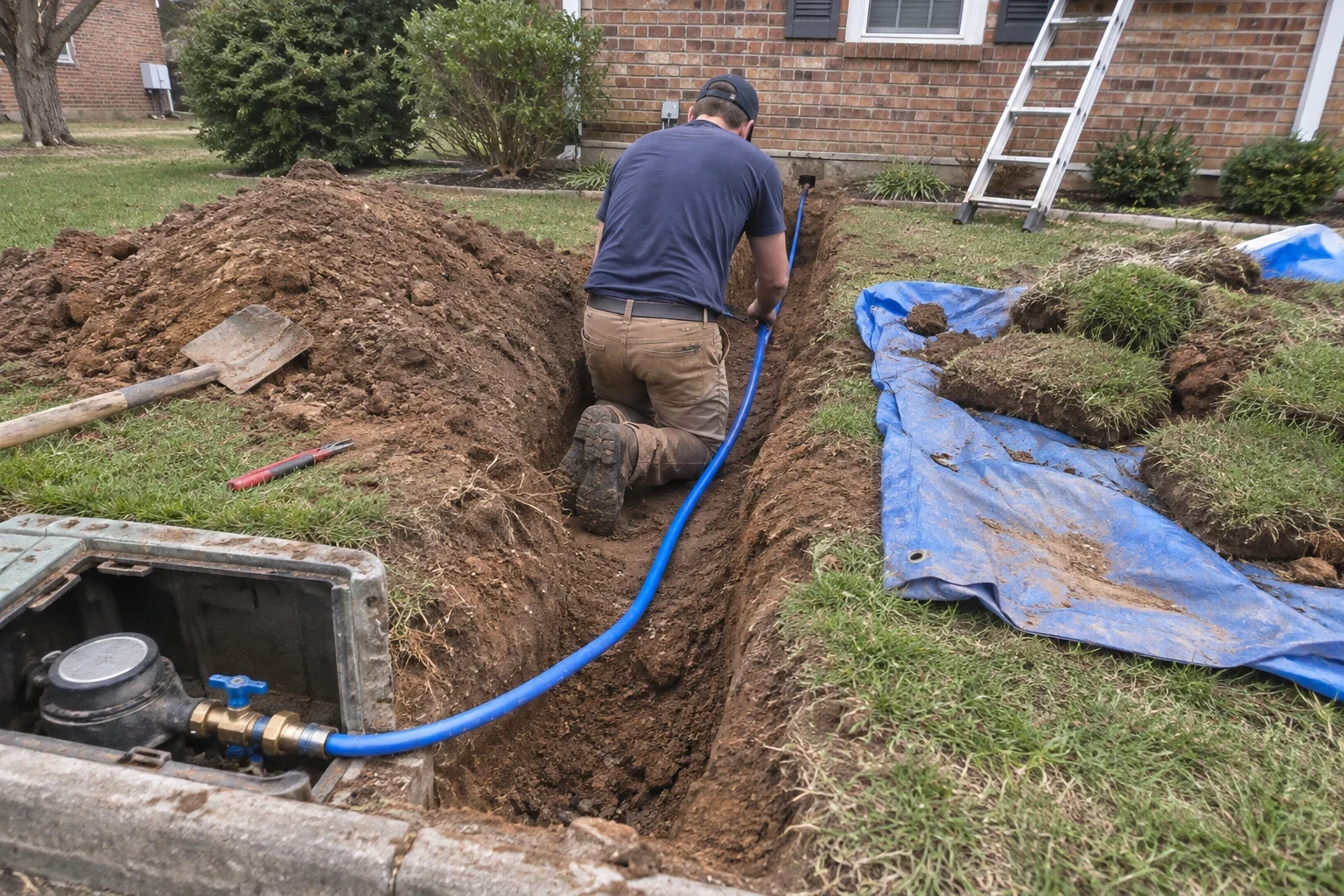
If the buried pipe feeding your home has rusted, split or no longer keeps up with your fixtures, we put in a new main line. It is sized for your household's demand, laid below frost depth and backfilled carefully so your lawn comes back.
What a main water line replacement involves
Your main water line is the buried pipe that carries city water from the meter or curb stop to the shutoff where it enters your home. Everything inside depends on it. When it starts to fail, patching one spot usually buys a few months before the next weak section gives out, because the whole run is the same age and material.
Older lines in Middle Tennessee are often galvanized steel, which rusts from the inside until the bore narrows, or polybutylene, a gray plastic that turns brittle and splits at the fittings. Some 3/4-inch copper lines are simply too small for a house that has added bathrooms. We replace these with PEX or HDPE rated for direct burial, or with type K copper where it makes sense.
We treat your yard like a neighbor's yard. We show you where the line runs, explain what we found, and tell you plainly whether replacement is the right call.
What the work includes
Locating the line and utilities
We have underground utilities marked before any digging. Then we trace the existing pipe so the new trench follows the shortest safe path.
Trench or trenchless installation
Most jobs use an open trench from meter to foundation. Where a driveway, mature tree or patio sits in the way, directional boring or pipe bursting can pull the new line through with only a pit at each end.
Correct pipe size and material
We size the line from your fixture count and the length of the run, often stepping up to 1-inch pipe to restore pressure. The pipe goes in below frost depth on a bed of clean fill so rock in our clay soil does not press against it.
Connections at both ends
At the meter we tie in on your side of the utility's connection. At the house we install a new main shutoff valve and, where incoming pressure runs high, a pressure reducing valve.
Pressure test and cleanup
Before backfilling, we pressure test the new line and check every joint. We then compact the soil in lifts, set aside sod where we can and haul away the old pipe.
Signs your main water line is wearing out
Flow is weak everywhere
If the kitchen, showers and hose bib all lose force together, the problem is upstream of the fixtures. Galvanized pipe choked with rust scale is a frequent culprit.
A soggy or sinking path across the lawn
Grass that stays green, soft or settles in a line between the meter and the house during dry spells usually means water is leaving the pipe underground.
Discolored water at the tap
Brown or cloudy water that runs clear after a minute can point to corrosion inside an aging steel supply pipe.
Bills climbing for no reason
Higher usage while your routine stays the same can mean the line is losing water before it ever reaches your home.
Old pipe material at the entry point
Gray plastic polybutylene or threaded steel where the line comes through the wall is near or past the end of its useful life, even if nothing seems wrong yet.
How the job runs
- 1
Inspection and free estimate
We check pressure at the house, look at the pipe where it enters, and walk the route from the meter. You get a written estimate that explains the method and the pipe we recommend.
- 2
Permits and locates
We arrange any permit the water utility or county requires and request utility locates. We set a start date with you so you know when the water will be off.
- 3
Dig, lay and connect
We excavate, bed the new pipe and make the connections at both ends. Most homes have water back the same day the line is tied in, though rock or a long run can add time.
- 4
Test, inspect and backfill
The line is pressure tested and left open for inspection when one is required. Then we backfill, compact and clean up the work area.
What moves the price of a new water line
We price each main line from what we see on your property, so the number comes after the inspection, not from a guess on the phone. That estimate is free and written out line by line. If spreading the cost over time would help, ask us about financing when we go over the estimate. You can pay with cash or any major credit card.
- Distance from meter to foundation
- The farther your house sits from the meter, the more pipe we lay and the longer the trench or bore. Required burial depth below the frost line adds digging on every foot of that run.
- Limestone and clay
- Shallow limestone shows up often in this part of Tennessee. Hitting rock can mean a heavier machine, a rock bit or careful hand digging, and each one changes the labor.
- Concrete, trees and beds over the route
- A driveway, sidewalk or established landscaping in the path affects which method we choose. Boring beneath them is frequently cheaper than breaking out concrete and pouring it again.
- Pipe diameter and type
- Going from 3/4-inch to 1-inch pipe for better flow, or picking type K copper instead of PEX or HDPE, shifts the material cost.
- Fittings, valves and permit fees
- A new main shutoff, a pressure reducing valve and any permit charges each get their own line on your estimate so nothing is hidden.
Main water line questions
Something not covered here? (615) 488-4514
Which part of the line do I own, and which part belongs to the water utility?
In most cases the utility is responsible for the meter and everything between it and the main under the street. From the meter to your house, the pipe is yours to maintain. Before we dig, we confirm exactly where that handoff point sits on your lot.
How much of my yard gets dug up?
An open trench is usually a narrow cut, roughly the width of a backhoe bucket. If the route crosses a driveway or a big tree's root zone, boring lets us keep the surface intact apart from a small pit at each end. We go over both methods with you during the estimate.
How long will the water be shut off?
Only during the cutover, when we disconnect the old pipe and tie in the new one. Most houses have water running again that same day, and we give you the expected window before work starts.
Do I really need the whole line replaced?
Not always. If one section is the only trouble, we will tell you that plainly. When the entire run is galvanized steel or polybutylene, though, the rest of it is the same age and tends to fail next, so replacing it once spares you a second excavation.
My main line burst after hours. Can someone come out?
Yes. Our 24/7 emergency plumbing service covers nights, weekends and holidays. We help get the water shut off at the meter or main valve to limit damage, then work out the replacement with you once things are under control.
Get a clear answer on your water line
Tell us what you are seeing, from low pressure to a soggy yard. We will set up a free estimate, or come out around the clock if water is running where it should not be.