Should I Hire a Plumber or Do It Myself in Watertown?
Some plumbing jobs take ten minutes and a wrench, and others can quietly damage your home for months if one fitting is wrong.
Should I hire a plumber or do it myself?
Do it yourself when the job stops at a fixture and you can shut off water right there, like a toilet flapper or a showerhead. Hire a plumber when the work touches gas, venting, the main water line or pipe inside walls, where mistakes hide or fail inspection. Free estimates at (615) 488-4514.
Which plumbing jobs can a homeowner safely do?
The safe jobs share two traits. The water to that fixture shuts off at a valve you can reach, and if the part fails you see it right away instead of behind drywall. These are worth learning, and we are glad to talk you through them by phone.
Hand tighten first, then go a quarter turn with a wrench. Most homeowner mistakes come from cranking down on plastic nuts and compression fittings until they crack or deform the ferrule.
- Replacing a toilet flapper or fill valve inside the tank
- Swapping a faucet aerator or a showerhead on existing threads
- Changing the cartridge on a whole-home water filtration system that is already installed
- Wrapping exposed pipes in a crawlspace or garage with foam insulation before a hard freeze
- Finding your main shutoff and turning it a few times a year so it does not seize
When does a job need a plumber?
Call a pro when the work changes how water, gas or exhaust moves through your home. These systems have code requirements for a reason, and the failure is often slow and out of sight.
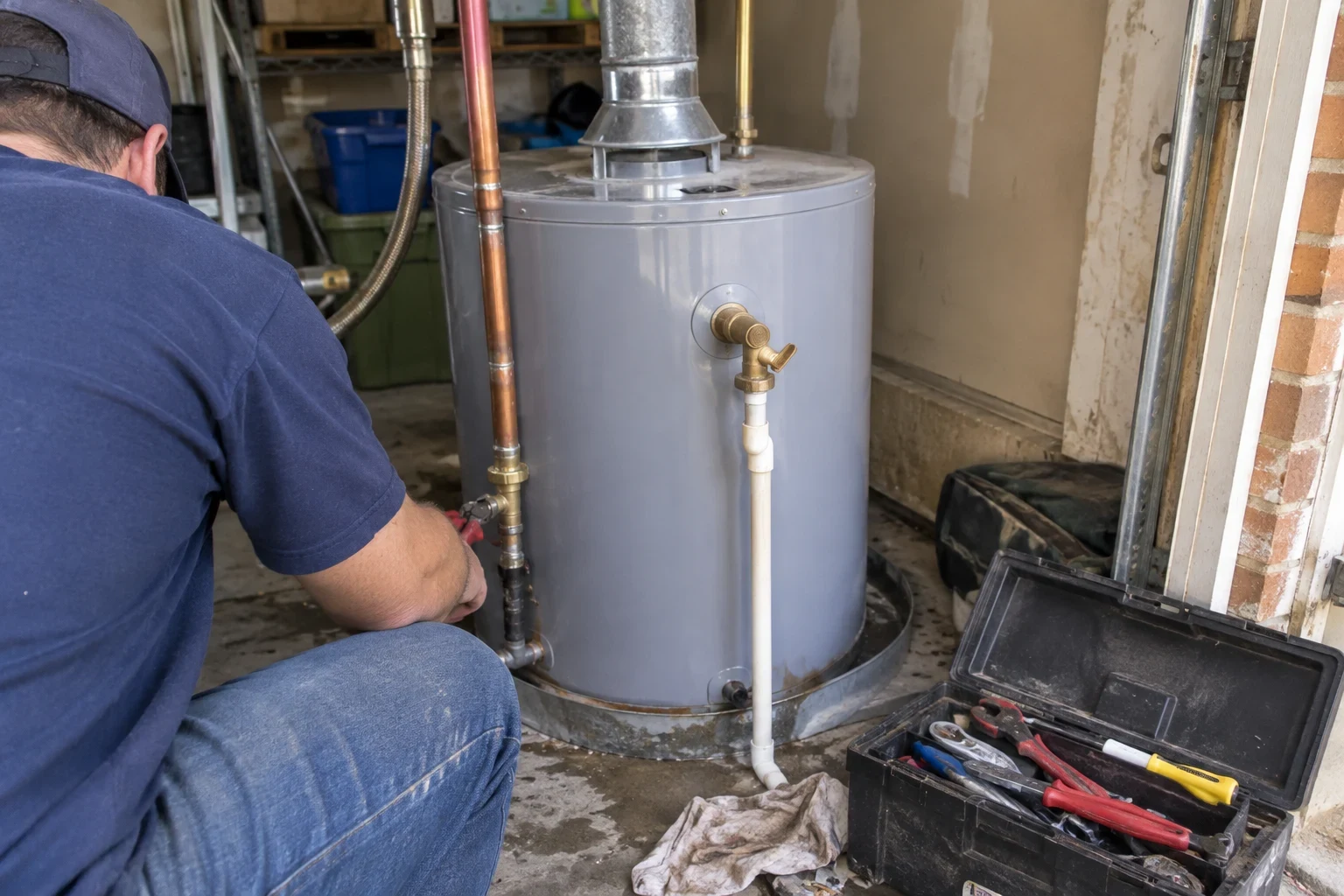
A water heater is the clearest example. The temperature and pressure relief valve needs a discharge line run to the right spot, gas units need correct venting so combustion gases leave the house, and many homes need a thermal expansion tank. Tankless water heater installation adds gas line sizing, because a tankless unit can draw far more gas than the old tank, plus condensate handling and new venting material.
Main water line replacement means digging a trench, keeping the new line below frost depth and making a tight connection at the meter side and at the house. Even whole-home water filtration, which looks simple, means cutting into the main line, adding a bypass loop and, on metal pipe, keeping the electrical ground continuous with a bonding jumper.
- Any gas connection or gas appliance
- Water heaters, tank or tankless
- The main water line from the meter to your home
- Cutting into supply pipe to add equipment
- Anything inside a wall, floor or ceiling
- New fixtures in a spot that never had plumbing
What goes wrong with DIY plumbing repairs?
The most common problem is mixing materials. Joining copper straight to galvanized steel without a dielectric union sets up galvanic corrosion, and the joint can fail years later. Push-fit fittings are handy, but they need a clean, square cut and the correct insert for PEX, or they can slip under pressure.
Middle Tennessee water tends to run hard because it passes through limestone. Scale builds up in valves and cartridges, so a part that seems fine on day one may stick or weep within months if it was the wrong type for hard water. A slow drip inside a wall can rot subfloor and grow mold long before you notice a stain.
Do permits matter for small plumbing work?
For fixture swaps, usually not. For water heaters, new lines and main water line work, a permit and inspection are often required, and rules vary by county and city, so check with your local codes office before you start. Unpermitted work can come up when you sell the house or file an insurance claim.
When we take on a job that needs a permit, we pull it and schedule the inspection, so the paperwork matches the work in your home.
How we handle the call
We treat a call the way we would want a neighbor to treat ours. If you describe something you can fix yourself, we will tell you so and walk you through it. If it needs a plumber, we look at it, show you what we found and give you a clear estimate before any work starts.
Estimates are free. We offer financing options and accept all major credit cards and cash. If water is coming through a ceiling at night, we run 24/7 emergency plumbing service across Watertown and nearby towns like Lebanon and Mount Juliet.
More questions about DIY versus hiring a plumber
- Is doing it myself always cheaper?
- Only if it goes right the first time. A wrong fitting or a missed permit can mean paying for the repair twice, plus any water damage it caused.
- What should I do while I wait for a plumber?
- Shut off the main valve, then open the lowest faucet in the house to drain pressure. If the water heater is involved, turn off its gas or the breaker so it does not run empty.
- Can I install the filter myself and have you check it?
- We would rather look at your setup first and tell you honestly whether it makes sense. A quick call costs nothing, and the estimate is free.
- Do you take care of homes outside Watertown?
- Yes. We work in Watertown and surrounding towns, including Smithville, Hartsville and Murfreesboro.
Not sure if it is a DIY job?
Tell us what you are seeing. We will say plainly whether you can handle it, and if not, give you a free estimate. For water where it should not be, we offer 24/7 emergency plumbing service.